Yasmin has been listed by Scotland on Sunday in a top ten of faces to watch in 2008. This is what they said.
"3 FILM Yasmin Fedda:
Fedda is the young Edinburgh filmmaker behind Breadmakers, which won the Short Scottish Documentary Award at last year's Edinburgh International Film Festival and heads for Sundance this month. In the past Fedda has filmed a desert monastery in Syria, members of the Afro- Cuban religion Santeria, and a group of pensioners in Damascus. This film, though, stays closer to home. Following a community of workers with learning disabilities working in a bakery in Gorgie, in Edinburgh, it's a beautifully observed study of the complex systems of communication that the group use as they knead their loaves. We think Fedda's going places, and not just in Gorgie."
The full article can be viewed at:
http://scotlandonsunday.scotsman.com/performing-arts/2008The-10-faces.3642782.jp
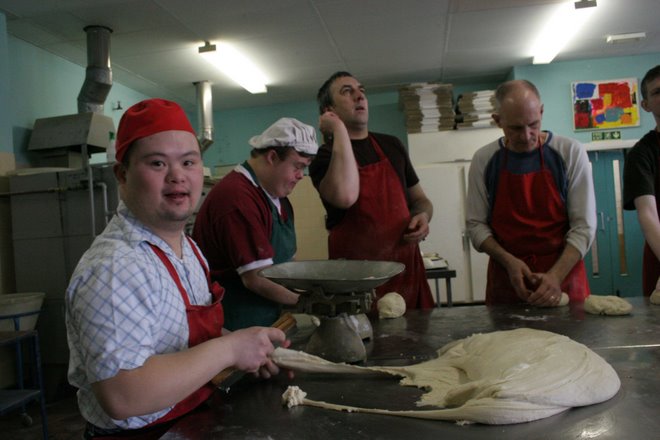
Is the dough in the right place?
Monday, 14 January 2008


French Toast
Breadmakers will be shown at The Quebec International Ethnographic Film Festival.
This internationally renowned ethnographic film festival has moved from being a Montreal based event to one that now spans the province of Quebec. The University of Chicoutimi has joined the festival’s committee, thus reaffirming the success of their annual events devoted to the discipline of visual anthropology.
This year, the FIFEQ is celebrating its fifth anniversary and they will be holding events in Montreal, Quebec City and Chicoutimi on January 25th, 26th, and 27th 2008. Photography exhibitions, discussion tables and conferences will be presented in order to enhance their wide variety of films chosen for the festival…all of which are free of charge for everyone!
Dedicated to the promotion of ethnographic films, the FIFEQ will screen films created by new filmmakers from both Canada and abroad as well as from renowned figures in the discipline of visual anthropology and the social documentary genre. The festival is both a celebration of the discipline of visual anthropology, as well as a reflection on the debates and ethical issues surrounding the utility and relevance of employing visual media when studying cultures and societies.
This has all been made possible due to the efforts of anthropology students from Concordia University, Universite de Montreal, McGill, University of Laval and the University of Chicoutimi. The FIFEQ creates a forum for professors, professionals, students and others passionate about films and anthropology to watch contemporary ethnographic films on the big screen and in turn to exchange ideas, pose questions and learn more about film media within the domain of the social sciences
This internationally renowned ethnographic film festival has moved from being a Montreal based event to one that now spans the province of Quebec. The University of Chicoutimi has joined the festival’s committee, thus reaffirming the success of their annual events devoted to the discipline of visual anthropology.
This year, the FIFEQ is celebrating its fifth anniversary and they will be holding events in Montreal, Quebec City and Chicoutimi on January 25th, 26th, and 27th 2008. Photography exhibitions, discussion tables and conferences will be presented in order to enhance their wide variety of films chosen for the festival…all of which are free of charge for everyone!
Dedicated to the promotion of ethnographic films, the FIFEQ will screen films created by new filmmakers from both Canada and abroad as well as from renowned figures in the discipline of visual anthropology and the social documentary genre. The festival is both a celebration of the discipline of visual anthropology, as well as a reflection on the debates and ethical issues surrounding the utility and relevance of employing visual media when studying cultures and societies.
This has all been made possible due to the efforts of anthropology students from Concordia University, Universite de Montreal, McGill, University of Laval and the University of Chicoutimi. The FIFEQ creates a forum for professors, professionals, students and others passionate about films and anthropology to watch contemporary ethnographic films on the big screen and in turn to exchange ideas, pose questions and learn more about film media within the domain of the social sciences
Monday, 24 December 2007
EIFF award winner selected for sundance
The short documentary about a unique community of bakers with learning disabilities set in Edinburgh’s Garvald Bakery, which received its premiere at EIFF 2007, also picked up a BAFTA Scotland nomination for Best Short Film.
Director Yasmin Fedda was thrilled when she discovered that Breadmakers was to be shown at Sundance, which runs from 17-27 January 2008.
“I’m looking forward to having pancake breakfast with Robert Redford! No seriously, I’m really pleased, especially for the Garvald Bakery.
“I would have never expected all the interest my film has had to date. Maybe people are taking to it because they can recognise themselves in these characters.”
Breadmakers was made as part of the Bridging the Gap New Talent Initiative, run by Scottish Documentary Institute and the scheme’s Executive Producer, Noe Mendelle, was delighted that the film will be showcased at North America’s biggest film festival.
“It’s our first film to get selected by Sundance, and we hope this is the first of many more in the future.
“It’s a great endorsement of our hard work in the last few years, and a brilliant way for Yasmin, and the Bridging the Gap scheme, to get noticed within the wider filmmaking community.”
Fedda will be joined at Sundance by fellow EIFF alumnus John Magary, whose short films The Second Line and Our National Parks received their World Premieres at EIFF.
The writer/director has been selected to participate in the prestigious Screenwriter’s Lab from January 11-16 with his debut feature project Blood Abundance, Or The Half-Life of Antoinette.
The intensive five-day workshop will be led by an extraordinary group of creative advisors, including Christopher McQuarrie and Thomas Vinterberg.
Thursday, 13 December 2007
Rising Stars
An article by JIM GILCHRIST of The Scotsman newspaper.
ALL hands to the table. There is the heavy thump of dough on flour-dusted stainless steel as the morning's batch of loaves and rolls takes shape; there is banter, snatches of a Christmas carol, and much whistling from Thomas. The baking of bread may be a linchpin of human existence, but for the workers in Garvald Bakery - tucked away behind a Volkswagen dealership on Edinburgh's Gorgie Road - making bread is more than just an age-old craft: it is their therapy and their key to broader integration into society.
For the breadmakers of Garvald Bakery are surmounting a wide spectrum of learning disabilities, from Down's syndrome to autisim spectrum conditions. Round the bakery table, they mix, knead and pummel their way into teamwork and job satisfaction, producing a range of organic breads for bakeries, delis and grocers in and around Edinburgh. And now this extraordinary little bakery is enjoying international recognition: a short documentary film about it, having won an award at this year's Edinburgh film festival and a Scottish BAFTA nomination, is bound for Hollywood legend Robert Redford's prestigious Sundance Film Festival in Utah next month.
Not only has the acclaim attracted by Yasmin Fedda's ten-minute documentary Breadmakers placed a welcome spotlight on the bakery and the Rudolf Steiner-inspired charity, Garvald Edinburgh, which runs it, but it also resulted in several of its bakers enjoying red-carpet treatment at the BAFTA Scotland awards in Glasgow last month. Among those hobnobbing with Lorraine Kelly and other glitterati at the awards ceremony were Sian Mayne and Nathan Reid, both of whom were kilted for the occasion. "I enjoyed the BAFTAS a lot," says Nathan, an affable 25-year-old. "I spoke to Lorraine Kelly - she's on TV - and I was dancing."
A trip to the Sundance Festival seems an unlikely prospect, given the costs and logistics, but Nathan is quite taken with the idea: "I've never been to America, but I'd like to try for the Sundance."
The baking, he says, is a satisfying business, "and I'm a great worker. I've done baking at my home and at school as well. And I've done special needs. I am special needs because..." he grins, "I'm very special."
"Special" they may be, but the establishment's Steiner ethos capitalises on abilities rather than dwelling on disabilities, explains Victor Chlebowski, the director of Garvald Edinburgh. "One of the beauties of this form of working is that it doesn't really matter what the dependency level or ability level of a person is, they all contribute to producing what will eventually be a loaf of bread, whether [they're] sweeping flour off the floor, kneading the dough or mixing it. People find their own level."
The attention generated by the Breadmakers has been a real bonus, says Chlebowski: "Yasmin, the director, was a one-to-one worker here for a while and because her background was in film-making, she saw potential in what was here. We were basically interested in a promotional DVD to go to parents and potential new members, but also to show the work we do in our own, Garvald way.
"But now there has been the added bonus of all the publicity, of people from here going off to the BAFTAs and now being recognised. It's just fantastic. It can't be anything other than helpful."
The Garvald presence at the BAFTA awards took the whole concept of inclusiveness that bit further, he adds. "It was all about integrating. They came away with autographs and with memories - they're still talking about it."
Breadmakers also went down well at a film festival in Teheran. Part of its apparent ability to travel well is doubtless down to its lack of any spoken narrative and its simple, direct but engagingly evocative recording of this most universal of occupations, accompanied only by snatches of conversation and singing, by the satisfying wallop of the dough off the table - and concluding with a virtuoso whistling solo from Thomas Griffiths.
Garvald Edinburgh, the charity which prompted the film, started in 1969 with a community house (named after a Steiner-inspired school established in Garvald House, West Linton, in 1944), and now operates from nine sites, providing "curative education" and social therapy. It is one of six Garvald operations in the Lothians and Borders, each with its own management and board structure. Some 115 people use the charity's services on a day basis, while a further 40 or so live in a care home or in supported tenancies. Productive activities include puppetry and puppet making as well as other craftwork, and refurbishing tools for Third World use. The Gorgie Road bakery opened in a former ice-cream factory in 1982.
As we talk, the morning production line is in progress, starting with Jamie Scott sorting out the day's orders - he flicks through the list for my benefit - it includes Butterflies Café, Real Foods, Tattie Shaws. One of the members will also accompany the van driver, explains Chlebowski:
"That's another aspect of integration, getting to know the routes, handling the money, social aspects of meeting the shopkeepers, so there's more learning going on." (And the van runs on an LPG and unleaded petrol mix, furthering the environmentally friendly Garvald ethos.) The members can also enrol for training modules in various skills - baking or otherwise - tailored to their abilities, in an accreditation programme run in partnership with Borders College.
Back at the table, Chuck Hong-Fung doesn't talk much - he has hearing problems - but keeps a quiet handle on the proceedings as he chops up a large wad of dough mix for the others to knead and roll into shape. Among the group is Donna Padget. When I ask her whether she likes working in the bakery she tells me she hates it - while beaming enormously - and that she'd rather have a rich boyfriend and a limo... to which there is no reply, really.
They don't play any music while they work - that would pose an unwelcome distraction - but there is continual chatter, snatches of song, whistling and the odd burst of what one might call baking aerobics from Thomas. While his baking skills may be limited, what he adds to the proceedings - and indeed to the film - in terms of spontaneous musicality are invaluable.
Also at the table is one of the centre's part-time one-to-one workers, Andrew Mill, a young graduate who helps Thomas. He loves working here, he says. In the meantime his other half has gyrated away from the table: "Thomas," hollers Andrew, thumping a wad of dough, "let's make bread." After the morning shift, he's taking Thomas swimming - cue a chorus of the Jaws theme tune.
Amid all the joshing, however, there is serious purpose here. As Chlebowki points out, these members are engaging in meaningful activity, with a clear end product which is in demand. The neatly rolled bread and rolls are now accumulating on racks, waiting to go into the prover, where they will rise, and then into the oven. Michael Valente is brushing baking tins with organic palm shortening (an alternative to margarine) while Nathan is placing rice-paper labels on each tin.
One of three workshop leaders, baker Stephanie Taylor, explains that in the morning session, they generally produce large and small wholemeal loaves, white country loaves and white and brown rolls. The afternoon shift makes a variety of "specials", such as Russian, Tibetan, oatmeal, walnut and malted grain breads.
How does such a disparate group work together? "They're coming here to do a job," she says, "most people take a lot of pride in their work. I think, myself, that we have as much to learn from them as they do from us."
It is, she agrees, a very elementary human occupation. "There's a lot to be gained from all coming round the table and kneading bread."
THE director of Breadmakers, Yasmin Fedda, confesses to being taken aback by the enthusiastic reception for her ten-minute film. "I did it because I wanted to make a film about that subject and that place," says Fedda, who spent a year as a relief worker at the Garvald Edinburgh bakery, "but I've been really surprised at the response."
Fedda, who is Lebanese-Canadian, came to Edinburgh University in 1998 to study social anthropology and went on to do a masters in visual anthropology at Manchester, Now, 27, she lives in Leith. She worked with young asylum seekers in Newcastle and in 2004 spent two months in a Syrian monastery which encourages Muslim-Christian relations, where she made a documentary, Milking the Desert.
The Breadmakers project arose with the offer of funding from the Bridging the Gap initiative, run by Scottish Documentary Institute to encourage new talent and funded by Scottish Screen, the National Lottery and the Skillset Film Skills Fund, among others.
After winning a Short Scottish Documentary Award at Edinburgh International Film Festival in August, Breadmakers was selected for the first International Documentary Film Festival in Iran where, again, it was well received, possibly due to the universality of its subject matter, and of course its lack of spoken narrative dispensed with any language barriers. "The only narrative," Fedda says, "is the bread."
Now the film has been chosen for the Sundance Film Festival in Utah: "That was another surprise, but it's really great. It will be good to share the work of the bakery and its approach to social care, and I hope to meet some interesting people and get ideas and feedback."
ALL hands to the table. There is the heavy thump of dough on flour-dusted stainless steel as the morning's batch of loaves and rolls takes shape; there is banter, snatches of a Christmas carol, and much whistling from Thomas. The baking of bread may be a linchpin of human existence, but for the workers in Garvald Bakery - tucked away behind a Volkswagen dealership on Edinburgh's Gorgie Road - making bread is more than just an age-old craft: it is their therapy and their key to broader integration into society.
For the breadmakers of Garvald Bakery are surmounting a wide spectrum of learning disabilities, from Down's syndrome to autisim spectrum conditions. Round the bakery table, they mix, knead and pummel their way into teamwork and job satisfaction, producing a range of organic breads for bakeries, delis and grocers in and around Edinburgh. And now this extraordinary little bakery is enjoying international recognition: a short documentary film about it, having won an award at this year's Edinburgh film festival and a Scottish BAFTA nomination, is bound for Hollywood legend Robert Redford's prestigious Sundance Film Festival in Utah next month.
Not only has the acclaim attracted by Yasmin Fedda's ten-minute documentary Breadmakers placed a welcome spotlight on the bakery and the Rudolf Steiner-inspired charity, Garvald Edinburgh, which runs it, but it also resulted in several of its bakers enjoying red-carpet treatment at the BAFTA Scotland awards in Glasgow last month. Among those hobnobbing with Lorraine Kelly and other glitterati at the awards ceremony were Sian Mayne and Nathan Reid, both of whom were kilted for the occasion. "I enjoyed the BAFTAS a lot," says Nathan, an affable 25-year-old. "I spoke to Lorraine Kelly - she's on TV - and I was dancing."
A trip to the Sundance Festival seems an unlikely prospect, given the costs and logistics, but Nathan is quite taken with the idea: "I've never been to America, but I'd like to try for the Sundance."
The baking, he says, is a satisfying business, "and I'm a great worker. I've done baking at my home and at school as well. And I've done special needs. I am special needs because..." he grins, "I'm very special."
"Special" they may be, but the establishment's Steiner ethos capitalises on abilities rather than dwelling on disabilities, explains Victor Chlebowski, the director of Garvald Edinburgh. "One of the beauties of this form of working is that it doesn't really matter what the dependency level or ability level of a person is, they all contribute to producing what will eventually be a loaf of bread, whether [they're] sweeping flour off the floor, kneading the dough or mixing it. People find their own level."
The attention generated by the Breadmakers has been a real bonus, says Chlebowski: "Yasmin, the director, was a one-to-one worker here for a while and because her background was in film-making, she saw potential in what was here. We were basically interested in a promotional DVD to go to parents and potential new members, but also to show the work we do in our own, Garvald way.
"But now there has been the added bonus of all the publicity, of people from here going off to the BAFTAs and now being recognised. It's just fantastic. It can't be anything other than helpful."
The Garvald presence at the BAFTA awards took the whole concept of inclusiveness that bit further, he adds. "It was all about integrating. They came away with autographs and with memories - they're still talking about it."
Breadmakers also went down well at a film festival in Teheran. Part of its apparent ability to travel well is doubtless down to its lack of any spoken narrative and its simple, direct but engagingly evocative recording of this most universal of occupations, accompanied only by snatches of conversation and singing, by the satisfying wallop of the dough off the table - and concluding with a virtuoso whistling solo from Thomas Griffiths.
Garvald Edinburgh, the charity which prompted the film, started in 1969 with a community house (named after a Steiner-inspired school established in Garvald House, West Linton, in 1944), and now operates from nine sites, providing "curative education" and social therapy. It is one of six Garvald operations in the Lothians and Borders, each with its own management and board structure. Some 115 people use the charity's services on a day basis, while a further 40 or so live in a care home or in supported tenancies. Productive activities include puppetry and puppet making as well as other craftwork, and refurbishing tools for Third World use. The Gorgie Road bakery opened in a former ice-cream factory in 1982.
As we talk, the morning production line is in progress, starting with Jamie Scott sorting out the day's orders - he flicks through the list for my benefit - it includes Butterflies Café, Real Foods, Tattie Shaws. One of the members will also accompany the van driver, explains Chlebowski:
"That's another aspect of integration, getting to know the routes, handling the money, social aspects of meeting the shopkeepers, so there's more learning going on." (And the van runs on an LPG and unleaded petrol mix, furthering the environmentally friendly Garvald ethos.) The members can also enrol for training modules in various skills - baking or otherwise - tailored to their abilities, in an accreditation programme run in partnership with Borders College.
Back at the table, Chuck Hong-Fung doesn't talk much - he has hearing problems - but keeps a quiet handle on the proceedings as he chops up a large wad of dough mix for the others to knead and roll into shape. Among the group is Donna Padget. When I ask her whether she likes working in the bakery she tells me she hates it - while beaming enormously - and that she'd rather have a rich boyfriend and a limo... to which there is no reply, really.
They don't play any music while they work - that would pose an unwelcome distraction - but there is continual chatter, snatches of song, whistling and the odd burst of what one might call baking aerobics from Thomas. While his baking skills may be limited, what he adds to the proceedings - and indeed to the film - in terms of spontaneous musicality are invaluable.
Also at the table is one of the centre's part-time one-to-one workers, Andrew Mill, a young graduate who helps Thomas. He loves working here, he says. In the meantime his other half has gyrated away from the table: "Thomas," hollers Andrew, thumping a wad of dough, "let's make bread." After the morning shift, he's taking Thomas swimming - cue a chorus of the Jaws theme tune.
Amid all the joshing, however, there is serious purpose here. As Chlebowki points out, these members are engaging in meaningful activity, with a clear end product which is in demand. The neatly rolled bread and rolls are now accumulating on racks, waiting to go into the prover, where they will rise, and then into the oven. Michael Valente is brushing baking tins with organic palm shortening (an alternative to margarine) while Nathan is placing rice-paper labels on each tin.
One of three workshop leaders, baker Stephanie Taylor, explains that in the morning session, they generally produce large and small wholemeal loaves, white country loaves and white and brown rolls. The afternoon shift makes a variety of "specials", such as Russian, Tibetan, oatmeal, walnut and malted grain breads.
How does such a disparate group work together? "They're coming here to do a job," she says, "most people take a lot of pride in their work. I think, myself, that we have as much to learn from them as they do from us."
It is, she agrees, a very elementary human occupation. "There's a lot to be gained from all coming round the table and kneading bread."
THE director of Breadmakers, Yasmin Fedda, confesses to being taken aback by the enthusiastic reception for her ten-minute film. "I did it because I wanted to make a film about that subject and that place," says Fedda, who spent a year as a relief worker at the Garvald Edinburgh bakery, "but I've been really surprised at the response."
Fedda, who is Lebanese-Canadian, came to Edinburgh University in 1998 to study social anthropology and went on to do a masters in visual anthropology at Manchester, Now, 27, she lives in Leith. She worked with young asylum seekers in Newcastle and in 2004 spent two months in a Syrian monastery which encourages Muslim-Christian relations, where she made a documentary, Milking the Desert.
The Breadmakers project arose with the offer of funding from the Bridging the Gap initiative, run by Scottish Documentary Institute to encourage new talent and funded by Scottish Screen, the National Lottery and the Skillset Film Skills Fund, among others.
After winning a Short Scottish Documentary Award at Edinburgh International Film Festival in August, Breadmakers was selected for the first International Documentary Film Festival in Iran where, again, it was well received, possibly due to the universality of its subject matter, and of course its lack of spoken narrative dispensed with any language barriers. "The only narrative," Fedda says, "is the bread."
Now the film has been chosen for the Sundance Film Festival in Utah: "That was another surprise, but it's really great. It will be good to share the work of the bakery and its approach to social care, and I hope to meet some interesting people and get ideas and feedback."
Sunday, 9 December 2007
Breadmakers fly to Indonesia
Breadmakers, along with the other 2007 Bridging the Gap films produced through the Scottish Documentary Institute, will be shown at the Film Festival Dokumenter, Yogyakarta, Indonesia.
Since its inception in 2001, the Festival Film Dokumenter (FFD) has endeavoured to revive the Indonesian documentary film and encourage the making of international-calibre, yet uniquely Indonesian documentaries.
This year, the festival celebrates documentary with a special focus on humanity themes, showcasing films from internationally renowned filmmakers.
The 6th Film Festival Dokumenter, Indonesia, takes place between December 10-15th 2007.
Since its inception in 2001, the Festival Film Dokumenter (FFD) has endeavoured to revive the Indonesian documentary film and encourage the making of international-calibre, yet uniquely Indonesian documentaries.
This year, the festival celebrates documentary with a special focus on humanity themes, showcasing films from internationally renowned filmmakers.
The 6th Film Festival Dokumenter, Indonesia, takes place between December 10-15th 2007.
A Star in the Shadow
Yasmin has been invited to appear at the Star and Shadow Cinema, Battlefield, Newcastle Upon Tyne, on Wednesday December 19th at 7.30pm where she will be in discussion with Light Bulb 08 Director, Craig.
Kuwaiti-born Palestinian film-maker Yasmin Fedda has a background in anthropology, and has worked on several film projects in the Middle East, USA and around the UK, including working with Bridge and Tunnel Productions in Newcastle. She comes to the Star and Shadow to talk about her life, politics, work, and future projects, all informed by a migratory life that has taken her from Palestine to Canada, Qatar to Scotland and Syria to Kuwait.
They will also be showing two of Yasmin’s short documentaries:
BREADMAKERS (2007, 10 min) looks at the intricate social relationships in a community of milking desertworkers with learning disabilities making a variety of organic breads for shops in Edinburgh.
MILKING THE DESERT (2004, 25 min) explores the life of Frederic, a French novice at the St. Moses the Abyssinian monastery deep in the Syrian desert. We follow him and Syrian monk Boutrous through their daily chores and routines: milking goats, making cheese and praying. Their lives create a backdrop for Muslim and Christian relations in the area.
Kuwaiti-born Palestinian film-maker Yasmin Fedda has a background in anthropology, and has worked on several film projects in the Middle East, USA and around the UK, including working with Bridge and Tunnel Productions in Newcastle. She comes to the Star and Shadow to talk about her life, politics, work, and future projects, all informed by a migratory life that has taken her from Palestine to Canada, Qatar to Scotland and Syria to Kuwait.
They will also be showing two of Yasmin’s short documentaries:
BREADMAKERS (2007, 10 min) looks at the intricate social relationships in a community of milking desertworkers with learning disabilities making a variety of organic breads for shops in Edinburgh.
MILKING THE DESERT (2004, 25 min) explores the life of Frederic, a French novice at the St. Moses the Abyssinian monastery deep in the Syrian desert. We follow him and Syrian monk Boutrous through their daily chores and routines: milking goats, making cheese and praying. Their lives create a backdrop for Muslim and Christian relations in the area.
Capital's Breadmakers to be toasted at Sundance
Taken from an article in The Scotsman Newspaper on the 7th December 2007.
FLAVOURED with linseed, walnut or oatmeal, organic bread from the Garvald Bakery is already famous with diners at some of Scotland's top eateries.
FLAVOURED with linseed, walnut or oatmeal, organic bread from the Garvald Bakery is already famous with diners at some of Scotland's top eateries.
Now a film about a unique community of bakers with learning disabilities is poised to spread the Edinburgh-based bakery's reputation to the United States.
Breadmakers, a 12-minute documentary, has won a screening at the prestigious Sundance Film Festival. The event, founded by the actor Robert Redford, is held in Park City, Utah.
The film, which has no voice-over or narrative, concentrates on about four adults from more than 30 who work in the bakery in the capital's Gorgie Road, part of the Garvald Centre.
Funded by the Bridging the Gap new talent initiative, the film has shown at the Edinburgh International Film Festival and at another festival in Iran.
Wednesday, 5 December 2007
Breadmakers do a Sundance
Breadmakers has been selected for the Sundance Film Festival. A delighted Yasmin was suitably excited. “It’s a big festival to be invited to. I will be making a big effort to attend”.
Each year the Sundance Film Festival selects 200 films for exhibition from more than 8000 submissions. More than 50,000 people attend screenings in twelve theatres in Park City, Salt Lake City, Ogden, and Sundance, Utah. In addition to discovering filmmaking's newest talent through the Festival's program of documentary, dramatic, and short film, Festivalgoers experience live music shows, panel discussions with leading filmmakers and industry figures, parties celebrating the Festival community, and more.
The Sundance Film Festival takes place from the 17th – 27th January 2008.
Each year the Sundance Film Festival selects 200 films for exhibition from more than 8000 submissions. More than 50,000 people attend screenings in twelve theatres in Park City, Salt Lake City, Ogden, and Sundance, Utah. In addition to discovering filmmaking's newest talent through the Festival's program of documentary, dramatic, and short film, Festivalgoers experience live music shows, panel discussions with leading filmmakers and industry figures, parties celebrating the Festival community, and more.
The Sundance Film Festival takes place from the 17th – 27th January 2008.
Monday, 26 November 2007
JURY DUTY IN WROCLAW
Yasmin’s success story continues. She has been asked to sit on the film jury at the Ofensiva International Film Festival, Wroclaw, Poland from 6th to the 9th December 2007.
The main part of the Festival will be the International Competition organized in four categories: plot, document, animation and video-clip. The competing movies will be judged by a professional jury. Moreover, during this year's edition in the cycle "World's Festivals" the festival will present images that were rewarded and appreciated from other festivals abroad; whereas in the cycle "New National Cinema" they will show the most interesting and the most important films from selected national cinematographers.
Audiences will have an opportunity to watch many films from all over the world that haven't yet been screened in Poland. In previous years the film festival has shown movies produced in distant and exotic countries such as; Georgia, Azerbaijan, Pakistan, Iran, Saudi Arabia, Argentina, Brazil, China, Taiwan, Singapore and India.
More details at: http://www.ofensiva.pl/eng/index.php
The main part of the Festival will be the International Competition organized in four categories: plot, document, animation and video-clip. The competing movies will be judged by a professional jury. Moreover, during this year's edition in the cycle "World's Festivals" the festival will present images that were rewarded and appreciated from other festivals abroad; whereas in the cycle "New National Cinema" they will show the most interesting and the most important films from selected national cinematographers.
Audiences will have an opportunity to watch many films from all over the world that haven't yet been screened in Poland. In previous years the film festival has shown movies produced in distant and exotic countries such as; Georgia, Azerbaijan, Pakistan, Iran, Saudi Arabia, Argentina, Brazil, China, Taiwan, Singapore and India.
More details at: http://www.ofensiva.pl/eng/index.php
MIND THE GAP
Yasmin Fedda is a Lebanese Canadian national, of Palestinian origin, raised in Kuwait. So what was she doing in Gorgie of all places? As she tells Malcolm Jack, it's all about bridging the gap.
Yasmin originally arrived in Scotland to study social anthropology in Edinburgh. After graduating, she moved to Manchester to do a postgraduate in visual anthropology, which is where she first started looking at life through the camera lens.
"I was doing an academic subject," says Yasmin, "and wanted to make it more accessible. I wanted to experiment with making films. Using socially interesting subjects, but expressing them artistically."
"I wanted to experiment with film, using socially interesting subjects, but expressing them artistically."
Yasmin's masters film Milking the Desert proved her first screen triumph, gaining selections and shortlistings at film festivals as far and wide as Sheffield, Paris, Moscow, Montreal and Rio de Janeiro.
"It was my first film, set in a monastery in Syria," she explains. "It was a mixed sex, mixed sect monastery in the desert, where they work toward better understanding between Muslims and Christians. It's politicised, but in a country where you're not supposed to be."
A further documentary, exploring the Afro-Cuban religion of Sanitaria in Miami - Siento Una Voz (I Hear a Voice) - followed, before Yasmin undertook projects in Newcastle and Edinburgh.
"I'm just happy people liked the characters."
Yasmin was working as a volunteer at the Garvald Centre in Gorgie - a centre for adults with learning difficulties - when she heard the call out for the Scottish Documentary Institute's annual Bridging the Gap scheme. The theme was 'white', something that brought to mind the Centre's bakery workshop, which makes organic bread for shops throughout the city.
"I thought about it for ages," she says, "then thought 'oh, flour and 'white', in the bakery context'. That wasn't enough, so I incorporated white noise - all the sounds of the bakery mixing together: the mechanical sounds, people singing and whistling and chatting."
Shot over two weeks, her ten-minute short gives an insight into the community and characters in the bakery, and the way they interact. It's really struck a chord with audiences since debuting at the 2007 Edinburgh International Film Festival, where it scooped the Scottish Short Documentary Award.
"I'm not sure why!" admits Yasmin. "The one thing people have commented on is the absence of voiceover. A lot of people thought it didn't need one - it's quite visual - they just had to watch it. And some people felt it's kind of rhythmical as well. I'm just happy people liked the characters."
"It's good that people are interested in seeing that kind of thing - it's not just about political polemics."
As mundane an environment as Breadmakers' setting might seem, Yasmin saw no reason why a film shot there shouldn't be as fascinating as her previous projects.
"The reason I liked working there in the first place was that it's a really interesting project," she says. "Even though my other projects seem really exotic and far away, to me they're all equal. And as an outsider going there, Gorgie seems just as exotic."
It might well take her to more exotic locations yet, because Breadmakers has been selected to screen at further festivals in Finland and Iran. Yasmin hopes to attend both, although immigration might prevent her visiting the latter.
"I'm going to try and make it," she says. "Whatever happens, it's just interesting that they picked it. I'm glad they picked a film that's about something really small. It's good that people are interested in seeing that kind of thing - it's not just about political polemics."
"I'd like to bring stories from the Middle East here and vice versa."
Yasmin hopes to work further through her films towards narrowing the cultural space between the West and Middle East. As a fluent English and Arabic speaker with a foot in both locations, she's in a great position to do so.
"It helps when you can speak the languages," she says. "I'd also like to bring stories from the Middle East here, because often I feel that people don't know what it's like. It would be nice to share what's happening there with other people. And vice versa."
So where to next then?
"Hmmm, let's see... Newtongrange?" she jokes. "At the moment I'm in Edinburgh, but perhaps somewhere in Syria, and hopefully Iran as well. That's the first port of call. And the West Bank hopefully, in Jerusalem. I'm developing a few projects. We'll see which one happens first."
This article was published on Channel 4’s 4Talent website at: http://www.channel4.com/4talent/feature.jsp?id=7706
Yasmin originally arrived in Scotland to study social anthropology in Edinburgh. After graduating, she moved to Manchester to do a postgraduate in visual anthropology, which is where she first started looking at life through the camera lens.
"I was doing an academic subject," says Yasmin, "and wanted to make it more accessible. I wanted to experiment with making films. Using socially interesting subjects, but expressing them artistically."
"I wanted to experiment with film, using socially interesting subjects, but expressing them artistically."
Yasmin's masters film Milking the Desert proved her first screen triumph, gaining selections and shortlistings at film festivals as far and wide as Sheffield, Paris, Moscow, Montreal and Rio de Janeiro.
"It was my first film, set in a monastery in Syria," she explains. "It was a mixed sex, mixed sect monastery in the desert, where they work toward better understanding between Muslims and Christians. It's politicised, but in a country where you're not supposed to be."
A further documentary, exploring the Afro-Cuban religion of Sanitaria in Miami - Siento Una Voz (I Hear a Voice) - followed, before Yasmin undertook projects in Newcastle and Edinburgh.
"I'm just happy people liked the characters."
Yasmin was working as a volunteer at the Garvald Centre in Gorgie - a centre for adults with learning difficulties - when she heard the call out for the Scottish Documentary Institute's annual Bridging the Gap scheme. The theme was 'white', something that brought to mind the Centre's bakery workshop, which makes organic bread for shops throughout the city.
"I thought about it for ages," she says, "then thought 'oh, flour and 'white', in the bakery context'. That wasn't enough, so I incorporated white noise - all the sounds of the bakery mixing together: the mechanical sounds, people singing and whistling and chatting."
Shot over two weeks, her ten-minute short gives an insight into the community and characters in the bakery, and the way they interact. It's really struck a chord with audiences since debuting at the 2007 Edinburgh International Film Festival, where it scooped the Scottish Short Documentary Award.
"I'm not sure why!" admits Yasmin. "The one thing people have commented on is the absence of voiceover. A lot of people thought it didn't need one - it's quite visual - they just had to watch it. And some people felt it's kind of rhythmical as well. I'm just happy people liked the characters."
"It's good that people are interested in seeing that kind of thing - it's not just about political polemics."
As mundane an environment as Breadmakers' setting might seem, Yasmin saw no reason why a film shot there shouldn't be as fascinating as her previous projects.
"The reason I liked working there in the first place was that it's a really interesting project," she says. "Even though my other projects seem really exotic and far away, to me they're all equal. And as an outsider going there, Gorgie seems just as exotic."
It might well take her to more exotic locations yet, because Breadmakers has been selected to screen at further festivals in Finland and Iran. Yasmin hopes to attend both, although immigration might prevent her visiting the latter.
"I'm going to try and make it," she says. "Whatever happens, it's just interesting that they picked it. I'm glad they picked a film that's about something really small. It's good that people are interested in seeing that kind of thing - it's not just about political polemics."
"I'd like to bring stories from the Middle East here and vice versa."
Yasmin hopes to work further through her films towards narrowing the cultural space between the West and Middle East. As a fluent English and Arabic speaker with a foot in both locations, she's in a great position to do so.
"It helps when you can speak the languages," she says. "I'd also like to bring stories from the Middle East here, because often I feel that people don't know what it's like. It would be nice to share what's happening there with other people. And vice versa."
So where to next then?
"Hmmm, let's see... Newtongrange?" she jokes. "At the moment I'm in Edinburgh, but perhaps somewhere in Syria, and hopefully Iran as well. That's the first port of call. And the West Bank hopefully, in Jerusalem. I'm developing a few projects. We'll see which one happens first."
This article was published on Channel 4’s 4Talent website at: http://www.channel4.com/4talent/feature.jsp?id=7706
Subscribe to:
Posts (Atom)